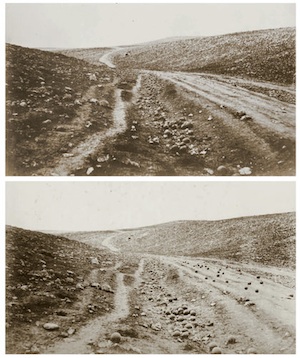
Sontag states that Fenton’s famous photograph, “The Valley of Death,” is the only one he took of the Crimean War that, “… reaches beyond benign documentation,” since he was limited in the scope of what he could photograph not only by his technology (15 second exposure times,etc) but by the orders from the war office he was given to avoid taking any pictures of the dead, maimed, or ill. She talks of how it is the only one of his images that would not need to be staged, since it evokes the story of the war specifically because of the absence of the actors. As a side note, I find it strange that she did not mention (did not know?) that it was staged, to a certain extent; he moved the cannon balls onto the road from where they had rolled off to the side. (I know this because I listened to a Radio Lab episode that examined the before and after comparison photos, both taken by Fenton. I have included the comparison of the two pictures here.)
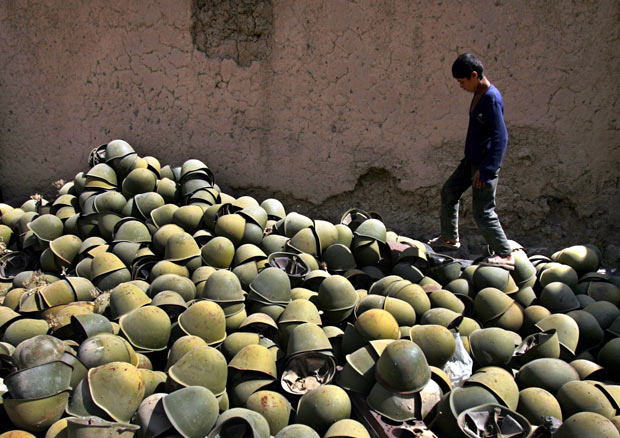
The photo I chose to accompany Fenton’s is this one from the Telegraph, from an article called “A Decade of War in Photos,” because it has the same effect of Fenton’s, telling a story about people who are not actually in the picture.
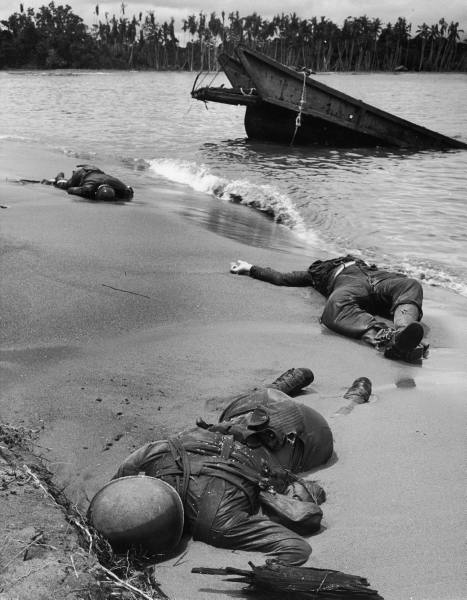
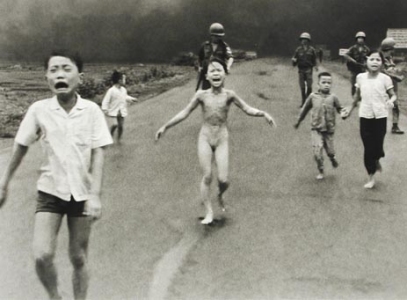
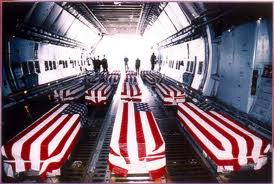
“What can be shown, what should not be shown—few issues arouse more public clamor.” Sontag, following observations of government or military censorship, as well as self-imposed censorship on news media in terms of images, discusses a point that I think is incredibly important: the tendency of finding a certain ease with portraying the death, suffering, and physical injury of the “other” side, but to award a certain dignity and respect to those on “our” side. The photo taken by George Strock, “Dead GI’s on Buna Beach” was shocking when it was published in Life in 1943, but it still followed a pattern: “photographs of anonymous American casualties … always prone or shrouded or with their faces turned away. This is a dignity not thought necessary to accord to others. The more remote or exotic the place, the more likely we are to have full frontal views of the dead and dying.” I Include Huynh Cong Ut’s photo of children badly burned by American napalm to illustrate the point.
The caskets I chose because this tendency persists. The citizens of the US still don’t see many pictures of their dead soldiers directly, while images of atrocities that are farther removed are more widely available. For a comparison, you can do the same search I did in google images: Dead American Soldiers vs Dead Taliban Fighters.
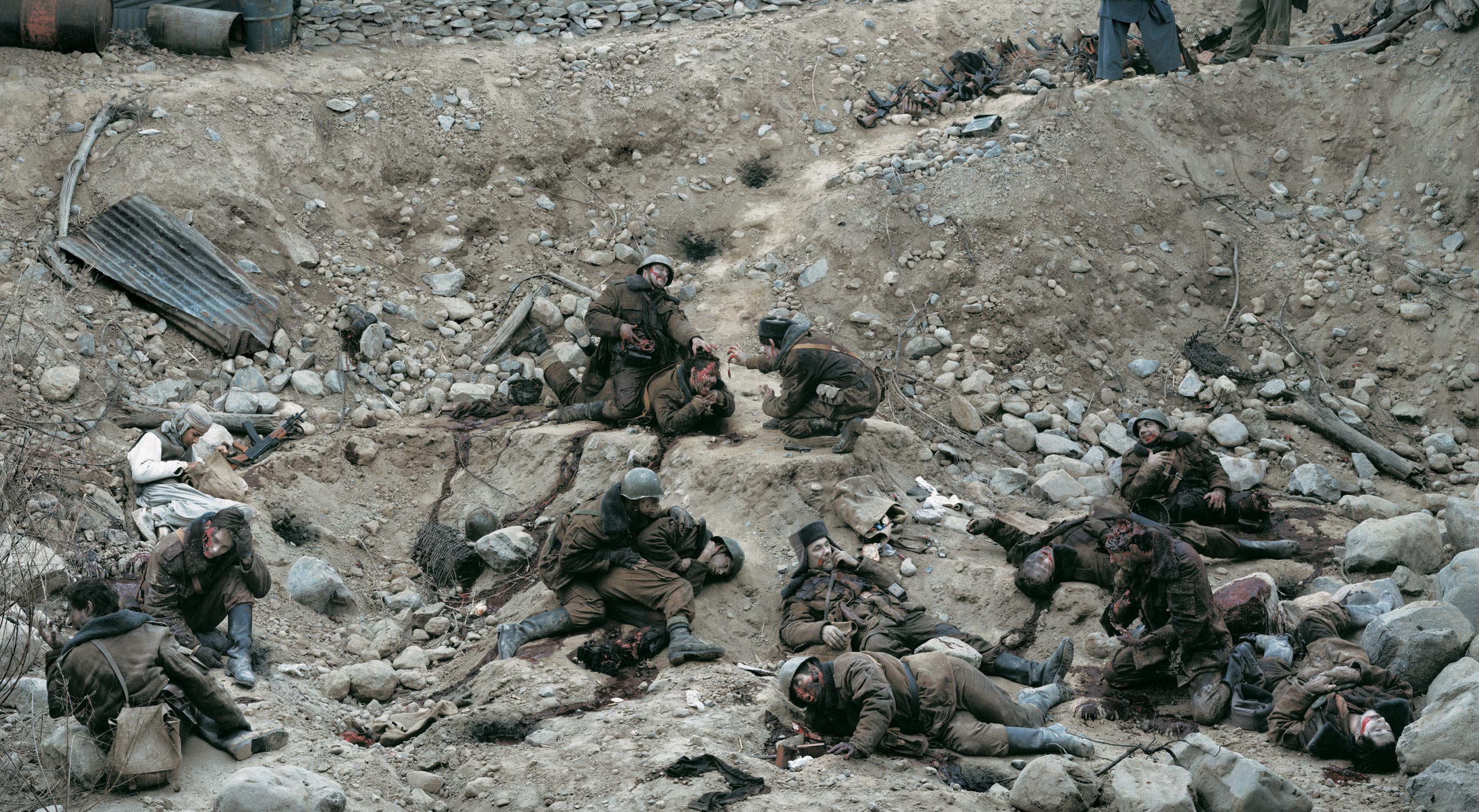
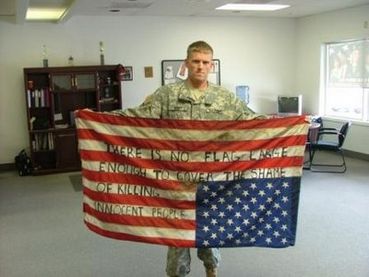
In “Dead Troops Talk,” a photo taken by Jef Wall, Sontag finds an answer to the question that she herself poses: “Could one be actively mobilized to oppose war by an image?” It is an antiwar picture, but manufactured through artifice. The setting is not in Afghanistan, but in a studio. With my background in theatre, I myself return again and again to the question why we need art, why we need to retell the stories repeatedly, why the original living was not enough. Sontag talks about modern life leaving little time and space for contemplation, for personal inquiry. Even with all the images that bombard us, we need our stories, our pictures, in order to provoke an inner landscape where reflection is possible. Wall’s photo, even though not “real” brings the reality of war home in a way that all those “real” pictures cannot do, and in that homecoming, the emotional response almost demands an intellectual one. As an anti-war message it is, in its own way, as explicit and troublesome as the one I included with it.
 Charlotte Jayelle Wheeler